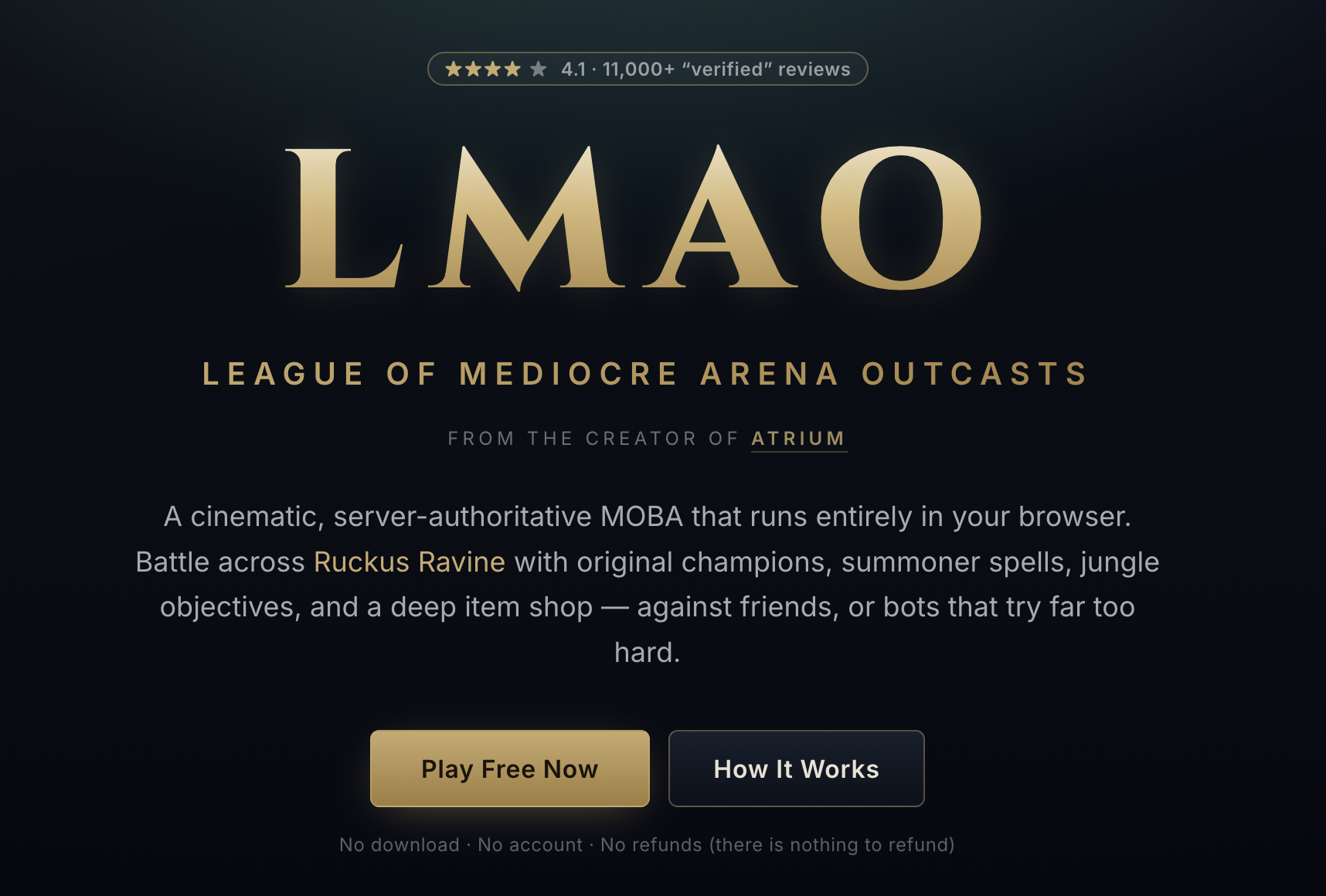
A developer named u/jonnygravity pointed Claude Opus 4.8 at League of Legends with one prompt: "build a temu League of Legends, web-only with online, room-based multiplayer." It built a fully functional version in one shot. Then he iterated.
The result is called LMAO, and it's playable right now in the browser with bots or friends.
Play it: lmaomoba.com
How it was built
The initial version came from a single prompt. From there, jonnygravity acted as project manager and let Claude do the engineering. The workflow had three phases:
- Sub-agents for art and design. Dedicated Claude sub-agents each focused on a single character, designing SVG art and then converting it to procedural Canvas for animation. Separate sub-agents handled ability design, SFX, and VFX. The prompt for animations was literally "go HOLY SHIT mode on the animations."
- Ultracode Workflows for optimization. Across a handful of prompts, Workflows handled performance tuning, game balance, and bug sweeps across the whole codebase at once.
- /goal for batch iteration. jonnygravity would play the game, note 10-15 tweaks and bug fixes, then hand the list to Claude via
/goaland let it run autonomously until everything was resolved.
The tech stack
- TypeScript + React for the frontend
- Canvas for all rendering and procedural animations
- PartyKit for real-time, room-based multiplayer
- SVG-first character art generated by Claude, converted to Canvas for performance
Everything runs in the browser. No Unity, no Unreal, no game engine. Claude built custom game logic, pathfinding, ability systems, and multiplayer sync from scratch.
What's in the game
It's more complete than you'd expect from a "vibe-coded" project:
- Multiple champions with unique abilities, all designed and named by Claude (Teemo became "Teehe")
- A full map with lanes, jungle mobs, and minion waves
- Bot opponents with three difficulty levels: Chill, Normal, and Sweaty (Claude named those too)
- Room-based multiplayer so you can play with friends
- Procedural VFX and SFX for every ability
The token bill
Total tokens used: 2.7 billion. That number sounds absurd, but most of it was cache reads at the discounted rate. The actual output (the code Claude wrote) was about 15.5 million tokens, which puts the API cost at roughly $6,600 at list price.
jonnygravity clarified he used Pro Max subscriptions for most of the work, not raw API billing. But the token count gives a sense of how much iteration went into refining every system.
Why this matters
The interesting part isn't the game itself. It's the workflow. Claude handled creative decisions (character naming, art direction, animation style, difficulty tuning) alongside the engineering. The developer acted as a project manager, not a programmer. That's a fundamentally different relationship with the model than "write me a function."
The sub-agent pattern is the key insight: rather than asking one context window to hold an entire game, each agent focused on a single domain (one character, one ability set, one map layer). That's how you get this level of detail without the model losing track of the bigger picture.
Reddit thread: r/ClaudeAI • Credit: u/jonnygravity